


A deal signed at Number 10 on Sunday tells you more about where the UK wants its energy future to go than about where it actually is. Rolls-Royce, the UK’s National Nuclear Laboratory (UKNNL) and Japan’s Atomic Energy Agency (JAEA) put their names to two cooperation agreements on advanced nuclear technology — and the choice of venue, during the visit of Japanese Prime Minister Sanae Takaichi, made the politics as loud as the engineering.
Here’s what was actually agreed, and what it does and doesn’t mean.
What was signed
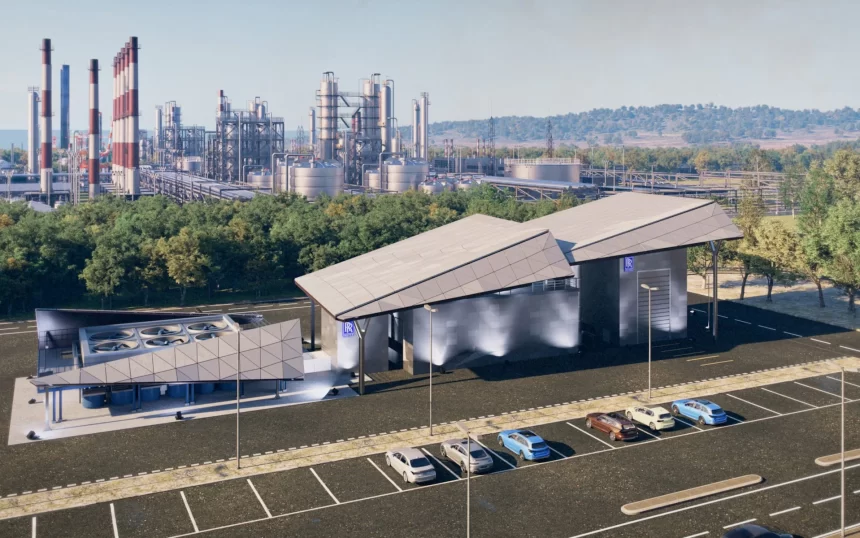
The three parties committed to collaborate on High-Temperature Gas-Cooled Advanced Modular Reactor (AMR) technology and the coated particle fuel that powers it. Crucially, these are Memorandums of Cooperation — agreements to pool research, skills and facilities, not contracts to build anything. The government wrapped them in its wider “golden age of nuclear” messaging and its Advanced Nuclear Framework, the route it has set up to give industry access to UKNNL’s expertise.
So treat the substance accordingly: this is an early-stage R&D partnership on a reactor class that is years, probably the better part of a decade, from commercial deployment in Britain.
Why AMRs are a different bet from SMRs
The easy mistake is to file this alongside the small modular reactors (SMRs) you’ve heard about. They’re not the same thing — and the distinction is the story.
SMRs, including the Rolls-Royce design already selected in the Great British Energy – Nuclear process, are essentially shrunken conventional reactors meant to feed the grid. AMRs run far hotter and are aimed at a different job: delivering high-temperature heat and off-grid power to industry, and potentially to defence sites — the hard-to-decarbonise corners of the economy that electrification alone struggles to reach.
For Rolls-Royce, this is a deliberate move to broaden its nuclear portfolio beyond the SMR it’s already banking on. (For the bigger picture on the company behind the SMR push, see our explainer on Great British Energy.)
The part everyone will under-report: the fuel
The genuinely significant element here isn’t the reactor — it’s the fuel. Coated particle fuel encases each speck of uranium in protective layers so it can withstand extreme heat, and it’s a specialist product the UK does not currently make at scale.
Building a sovereign capability to qualify and manufacture that fuel is an energy-security play as much as a clean-energy one. A Britain that can produce its own advanced reactor fuel is a Britain less exposed to the enriched-fuel supply chains currently dominated by a handful of countries — a vulnerability the war in Ukraine made impossible to ignore.
That’s the strategic logic worth watching, and it’s why bringing in Japan, which has deep high-temperature reactor experience, matters more than a typical bilateral photo-op.
The reality check
Now the cold water. Britain is exceptionally good at announcing a nuclear renaissance and considerably less good at delivering one on time or on budget — Hinkley Point C is the standing monument to that gap.
An MoU signed during a state visit is, in part, diplomatic theatre: it signals intent, shores up an industrial relationship and gives two governments a shared headline. None of that is worthless, but none of it is a megawatt either.
The questions that will actually determine whether this matters are unglamorous: How quickly does the fuel-qualification work move from agreement to facility? Does AMR development attract real capital, or stall behind the SMR programme competing for the same money and skills?
And does the regulatory route the government keeps promising actually compress timelines, or just add another framework to the pile?
The bottom line
The direction is defensible — arguably smart. Advanced nuclear that delivers industrial heat, off-grid resilience and sovereign fuel capability addresses three things the UK genuinely needs, and partnering with Japan is a sensible way to buy in expertise rather than reinvent it.
But this is a signing, not a switch-on. Judge it, like every nuclear announcement, by what gets built and when — not by who stood where in Downing Street. On that scoreboard, today’s read is: promising intent, clock now running.
Sources
- “Rolls-Royce, United Kingdom National Nuclear Laboratory and Japan Atomic Energy Agency to co-operate on advanced nuclear technologies,” Rolls-Royce press release, 14 June 2026
- Great British Energy – Nuclear, SMR selection process (background)